Labor Day Greetings 2024!

Coworkers, comrades, and fellow labor activists—wishing you a restful Labor Day weekend!

In keeping with our radical political traditions, we put our activist energies into May Day, not Labor Day. This doesn’t mean that we haven’t been craving a rest from the bone-aching grind of our labor. In our WSA branch, we are furniture movers, home workers, pink collar assistants, and healthcare workers. We all need a rest from exhaustion. This three day weekend is needed to recover.

Labor Day was fought for and won by workers. But we also know that this is far from enough. It’s a drop in the bucket.

Labor Day, with its parades and picnics, took the shape of a more capitalism-friendly alternative to the more radical May Day that was characterized by street protests and strikes.

While we focus our eyes on May Day, you will still see us with friends at local Labor Day events, re-affirming the community aspects of our work lives. We need to recuperate in preparation for amplifying workplace voices and building relationships. As we know, building relationships is the heart of organizing. So, strike up the grill. But tomorrow, we build the General Strike ! 

From Philly Metro WSA 

“We are committed to building a future rooted in a classless and stateless society, where we, as working people, create workplace and community democracies that prioritize human needs over profits for the few. Our vision is a world free from the social oppressions of racism, sexism, and queerphobia. Through our revolutionary unions, we will transform the nature of work, paving the way to our collective liberation.”

From Greater Chicago WSA 

Third Annual May Day A Success ! 

By Greater Chicago WSA

Reprinted from WSA Discussion Bulletin # 75

1

Wednesday, May first, at 8 30 pm EDT, workers from around  the country and Canada gathered for our third annual May Day online event. 

The recent passing of our beloved Clarissa, who was pivotal in the first two years of our evening May Day, was frequently mentioned through the gathering. 

The opening song, by Martin Traphagen, ‘Arrival,’  was inspired by Clarissa. 

The third annual May Day Speech, this year delivered by Rebecca Croog, vividly described the impact that Clarissa had on her work:  “As I find my way into this work, I am visited multiple times a day by the memory and spirit of our Comrade Clarissa, who we recently lost to long covid. I can hear her encouraging us: 

‘Don’t mourn, organize!’ I can feel her galvanizing us: ‘Let’s build coalitions! Let’s make this moment bigger and bigger!’ Gathered together as an anarcha-syndicalist community, let’s invite her in to remind us: ‘ALL BUILDS TO THE GENERAL STRIKE’ 

Rest in power, Clarissa! Free Palestine!”

As attendance increased, speakers reported on recent health care labor struggles, and one of the founding members of WSA, Steve Rabinowitz, read from the history of the Haymarket Martyrs, specifically the words of August Spies. 

After the formal program, attendees shared news of May Day events and Gaza actions in their areas, from Philadelphia, Asheville, Greater Chicago WSA and other cities. 

Comrade Greg McGee shared breaking news of attacks on the Ceasefire Gaza encampment at Columbia University. 

Rebecca shared news of her work with Jewish Voice for Peace, recent union drives, and workers  standing up for Gaza. 

At one point everyone joined in singing happy birthday to our comrade Alexandra, who is a May Day baby!!

2

As the meeting wound further down, comrades stayed for more informal discussion. Comrade Mitchell, (WSA zone 2 delegate in Oregon), asked what anarchist-syndicalists make of Rosa Luxembourg. This led to an energetic discussion on how anarchists can build relationships with anti-authoritarian Marxists, such as council communists and anti-state Marxists, outlining how Luxembourg’s work prefigured councilism, lamenting how Trotskyist groups have claimed her. Like later councilists, her criticism of anarchists seemed to be more that, at that moment, they were disorganized and had little capacity, different from criticism of organized libertarian communism itself. 

By this point there were a few brave and sleepy comrades engaging in this conversion, and there were warm goodbyes. And for annual attendees not part of WSA, there were hopes to see everyone on May Day 2025! 

Below is Martin’s opening song ‘Arrival’, in honor of Clarissa –

Clarissa Rogers: Working Class Theorist

 By Rebecca Croog, An interview series with Sachio Ko-yin.

“In order to have a society where workers manage themselves collectively, we need all of our best group process skills. To have a culture that values all voices and all people equally in decision-making, we need to practice ways of working together that don’t reproduce oppression. Deliberation takes practice!”  Clairssa Rogers 

On March 13th, 2024, our dear comrade Clarissa Rogers, longtime anarchist organizer and theorist, made her transition after a hard-fought battle with Long COVID. To honor her and as a service to the anarchist movement, we are sharing a series of interviews we did together about Clarissa’s anarchist theorizing and research. Our hope, as was Clarissa’s, is that her ideas and her overall journey as a working class theorist will inspire and galvanize other working class people to seize intellectual power and pursue collective education as part of liberation struggle. 

The question of “who is the working class?” heavily motivated Clarissa’s theory work. As an anarcha-syndicalist, Clarissa brought an intersectional lens to this inquiry, meaning that she was committed to hearing  and theorizing with the vast number of women, queer people, Black folks, and other non-white workers that make up the working class–groups that traditional anarcho-syndicalism largely ignored, to the great detriment of the movement itself. With this framework always at the fore, Clarissa developed a number of specific concepts, which we explore in detail throughout these interviews. These include: the philosophical implications of anarchist decisionmaking tactics, small group sociology of anarchist communities, anarchist pedagogy and worker self education, working class intellectualism, critical theory of anarchist group processes, and many more. 

In Part One of this series, we set the scene, through a discussion of Clarissa’s arrival to Philadelphia in the late 90’s , a golden era of West Philly Anarchism. 

We want to offer a disclaimer about the imperfection of memory as it relates to this project. Many of the experiences and conversations that Sachio recounts in these interviews happened decades ago, and these first interviews were conducitd while Sachio was arranging for Clarissa’s memorial and literary estate. We are well aware that many other comrades had the honor of participating in Clarissa’s intellectual journey. We invite plenty of space for corrections, additions, and clarifications. This is a first draft, a living project, as Clarissa herself remains a living memory to us all.

Part One: Setting the Scene – Clarissa in Anarchist West Philly

Rebecca: I thought it could be good to start very broadly, by asking you to tell me the story of how you and Clarissa first met. I know it was in 2003 in West Philly. Where exactly were you and what do you remember about that initial interaction?

Sachio: Alright so to provide some context, I’d come to Philly right as the anti-war movement was ramping up. I remember that there was a meeting of this nice United Nations group, Earth Charter Citizens. And they had on their agenda to talk about the possibility of building a coalition for the anti-war movement in Philly. So I don’t know if they really intended for that meeting to be a coalition meeting, but I jumped on the opportunity. I was new to the city, but I called up all of the Philly organizers I had met so far, and everyone who knew anyone who was doing anti-war work. I wanted to find anyone who might be interested, and to try to get as many groups as possible into that Earth Charter Citizens Group meeting. So we ended up with this giant–these poor Earth Charter Citizens–this giant room full of the Philadelphia left, pacifists, anarchists, Stalinists, free market republicans, and assorted quirky people. So that started the ball rolling of me doing facilitation in Philly. For about two or three meetings, I was trying to facilitate discussion about how the organizers were going to build a coalition.

So it was after one of those meetings that I was on the 36 trolley, the one that goes into West Philly, riding right along Baltimore Ave, and along that route, someone came up, and it was Clarissa Rogers! I’d never met her before and she came right up to me and said, “you were at the meeting last night. YOU are a good facilitator!” And I said, “thank you so much!.” She told me that facilitation was her main thing, and said, “you probably know my friend Daniel Hunter” and I said “oh yes Daniel Hunter!” so we ended up making a connection. 

Rebecca: Wow, so if facilitation was Clarissa’s main thing and you were newer to it, her compliment must have felt like a high honor! What happened next?

Sachio: Yes, exactly! So what happened next is that Clarissa invited me over to her place to discuss a bunch of  projects that were coming out of that coalition. The Coalition, by the way, came to be known as PRAWN (Philadelphia Regional Anti-War Network), a very funny acronym, but that’s what we were–we were PRAWN. And so that work, that was my first experience of radical West Philly! And there were so many things happening at once at the time, so much excitement. So, I of course took Clarissa up on her offer, and went right over to her place, and it turned out to be one of this group of anarchist houses that existed at the time. 

Rebecca: Ooh cool! As you know, I am so eager to talk about the geographies of West Philadelphia and anarchism as part of this interview, especially because you, me, and Clarissa all share a love of critical geography. Take me into that world!

Sachio: So Clarissa was living in one of these anarchist houses, and hers was called “the Cindergarden.” The name was like, ya know if you take cinder blocks and turn them into a garden you have Cindergarden… Cindergarden was right down the street from another anarchist house called “Not Squat.” It was called that because squats don’t have permission to exist, but all of these houses were actually part of the Land Trust that was left over from the Movement for a New Society. So it was “Not Squat” like “THIS IS NOT A SQUAT,” but it was like a squat, it was like a squat where they had permission. So right there was Cindergarden, there was Clarissa, and there was a whole giant community of these punk anti-globalization activists running all over the place working on projects, living in community, having all sorts of personal drama, and sitting around strumming the guitar late at night. These were my first impressions… the walls were crumbling down and when you took a step on the floor, I remember, you may just have to be careful that you don’t fall through the floor. That was my recollection. 

So Clarissa meets with me there, she introduces me to a bunch of people, and we’re sitting down and we’re working on something related to peacekeeping. More specifically, what we were working on was helping out the peace keeping trainer Dion Loreman. For some context, Dion Loreman was a member of the Movement for a New Society back in the 80s, which was this giant nonviolent anarchist organization in Philly that prefigured a lot of anarchist history that came later after that–I mean obviously anarchism in Philly goes all the way back to the 19th century…

Rebecca: How did the rest of the West Philly anarchists feel about the peacekeeping trainings? 

Sachio: Yes, this whole idea of ‘peacekeeping’ seemed controversial in the West Philly scene. Clarissa was helping me navigate some of this controversy, because she felt that when you have a giant demonstration, the more we can be coordinated and in communication with each other, and deal with conflict on our own, the more we can keep the police from having an excuse to jump in and try to mediate our conflicts for us. So, some folks in the West Philly  movement were very skeptical about this, they called us the “self appointed peacekeepers.” Clarissa was so crucial at that time in really helping me understand the local culture and helping me reach out to the West Philly activists. 

And of course I had tons of history questions, about how this whole anti-authoritarian community in West Philly had come into existence. I had just come from Central Pennsylvania, where I did two and a half years for an antinuclear weapons protest. And when I was there, there was this guy named Eric from Williamsport, a fellow anarchist, who was moving to Philly at the time, and said something like “Sachi, you gotta come to Philly. All the anarchists are moving to Philly, from all over the place, it’s really happening!” So I had already gotten some idea that there was a really big burgeoning new infrastructure of a very DIY antiglobalization movement. 

Rebecca: This is SO you and Clarissa, to be diving right into all of these questions about the culture and structure of an activist community you were a part of, figuring out how to build coalitions and accomplish goals amidst various internal conflicts and tensions. 

Sachio: Right, exactly! So in my first conversations with Clarissa about Cindergarden, I had so many questions about … what is going on here? What does anarchism mean here? How do you guys make decisions? And Rebecca, you and I of course  have had so many conversations about infrastructure anywhere we go, infrastructure in a region, of course, because we are critical geography partners… well oh boy I had questions about infrastructure in this very specific anarchist West Philly area! So those questions took up much of our conversation, and Clarissa was very happy to map it all out for me, she was very excited to talk about it. So that was my first experience with Clarissa, and it was immediately clear to me that Clarissa and I would become comrades in anarchist organizing, but also someone I could do anarchist theorizing with, and later, social science with. And as you point out, this initial conversation fits right in with everything that was to come.

Stay tuned for our next piece in this series, which begins with a discussion of Clarissa’s quirky coinage of “planarchy” and how it relates to her thinking around social anarchism, anarcha-syndicalism, and anarchist tactics. 

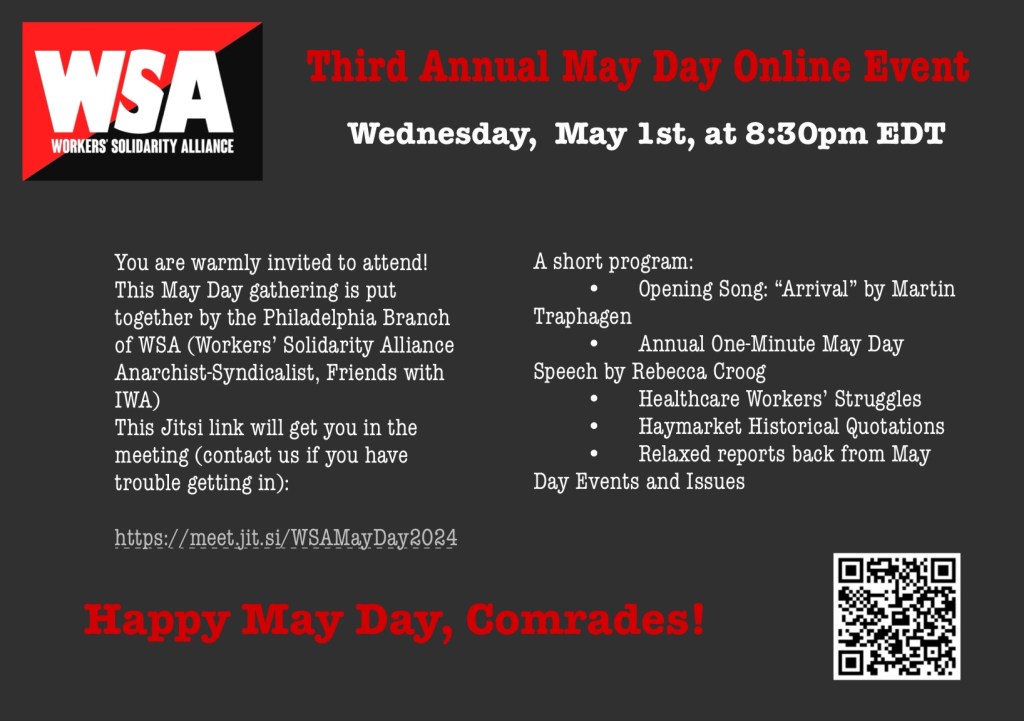
Third Annual May Day Online Event

Dear Comrades, you are warmly invited to attend!

This Wednesday, May 1st , at 8:30 EDT 

Here is the link:

https://meet.jit.si/WSAMayDay2024

Opening Song by Martin Traphagen: “Arrival”

Annual One-Minute May Day Speech, by Rebecca Croog 

Heath Care Workers’ Struggles 

Haymarket Historical Quotes 

Relaxed Reports Back from May Day Events and Issues 

See you there!

This Wednesday- KROPOTKIN’S MUTUAL AID READING GROUP 

YOU ARE WARMLY INVITED TO OUR NEXT MEETING:  

Wednesday Jan 17 8pm est

FOLLOW LINK TO JITSI 

https://meet.jit.si/MutualAidReadingGroup2023

This reading group is a project of the Labor Committee of Workers Solidarity Alliance — all are welcome whether or not you’ve read the book. Our goal is to help make this difficult book as accessible as possible in a relaxed environment. 

Download PDF here

If you’d like to stay in the loop, send us an email: philly-metro-wsa@proton.me

This meeting we are discusing Chapter 1: Mutual Aid Among Animals below is an Audio Version of Chapter 1

Audio, Chapter  1, Mutual aid among animals

Below is a helpful over all introduction  to Mutual Aid.

Some questions we might include:

  • What does Mutual Aid mean to us today as Anarchist-Syndicalists?  
  • What was the geographic and biological/evolutionary science of Kropotkin’s time? 
  • How does Kropotkin’s ethical and political values connect to his scientific worldview? 
  • How does this book relate to the tradition of Anarchist Geography? 

An Introduction to Mutual Aid – 

Kropotkin: Part One: Mutual Aid – Kropotkin and Darwin

Kropotkin: Part One: Mutual Aid – Kropotkin and Darwin

An account of our first meeting, from Impulse.

An International Gathering in Pursuit of Mutual Aid: An Exploration of Kropotkin’s Ideas and Legacy

Backstory

Our comrade Clarissa proposed this reading group, after a conversation with a fellow activist about Mutual Aid being a revolutionary act. 

“My response was to really ask myself, well, what is mutual aid, really? And is it always as revolutionary as we make it out to be?” 

She realized she’d never read Kropotkin’s Mutual Aid. Since this book has had a far-reaching impact on the anarchist and Syndicalist movements, reading the book and the history of its influence would be a good project for us. 

She proposed this reading group could be a kind of small focus group on the question of what Mutual Aid is, and what our anarchist and syndicalist literature means when we use the word Mutual Aid. And further, how do our Revolutionary Syndicalist commitments relate to  science in our own time?

Especially now, in a time of pandemic, we are more likely to use the word Mutual Aid in our propaganda, as a uniquely anarchist  contribution to overcoming the catastrophe.

This could be a perfect time for us to make this re-examination, to ask ourselves some harder questions of when, and under what conditions can Mutual Aid be revolutionary?

An International Gathering in Pursuit of Mutual Aid: An Exploration of K…By Hanna Waldman In an intimate yet global gathering, a group of like-minded individuals from multiple contine…

An International Gathering in Pursuit of Mutual Aid: An Exploration of Kropotkin’s Ideas and Legacy


By Hanna Waldman  

In an intimate yet global gathering, a group of like-minded individuals from multiple continents came together for the first time under the banner of the Mutual Aid Reading Group, organized by the Labor Committee of Workers’ Solidarity Alliance.

Participants, including Clarissa (who masterfully facilitated the discussion), Sachio, Danielle, Rebecca, Melissa, Gen, and Adam, took part in a thought-provoking discussion aiming to delve into the ever-relevant concept of Mutual Aid, as described by anarchist philosopher Peter Kropotkin.

The session began with introductions and shared hopes and fears for the discussion. The complexity of Kropotkin’s Mutual Aid soon became apparent—it has been misused as a buzzword synonymous with charity or donations, particularly during the pandemic. However, as the reading group explored, it’s much richer and quite multidimensional, with its roots deeply embedded in the sciences.

Sachio took the lead by summarizing Kropotkin’s magnum opus, published in 1902. The key message: Mutual support among species is a significant factor in evolution, which Kropotkin contrasts with the acts of selfishness found in systems like capitalism, where grassroots processes are often taken over by centralizing forces.

Rebecca wisely reminded the group that Kropotkin didn’t believe mutual aid to be the single most important factor in evolution. He maintained an intellectual humility, acknowledging that more research was needed to understand its relationship with individualism.

Clarissa brought up an intriguing point regarding the disproportionate focus on competition and war in historical studies. Kropotkin sought to redress this imbalance by shining a light on cooperation and mutual aid.

Reflections were abundant and insightful. Sachio expressed admiration for Kropotkin, even as he acknowledged a potential fallacy in deriving an ethical argument from biological sciences. Danielle raised similar concerns, questioning Kropotkin’s selective use of animal examples to support his thesis.

Adam brought the historical perspective into focus, reminding the group of the influence of the Progressive Era’s mindset on Kropotkin’s work. Alex drew a parallel between Kropotkin’s mutual aid and the symbiotic networks found in nature—like mycorrhizal networks, wherein individual competition and mutual aid coexist depending on the environmental context.

Gen introduced the issue of reciprocity, suggesting that Kropotkin held mutual aid in higher esteem. This led to a broader discussion initiated by Harold Barkley’s perspective on stateless societies and their often problematic male domination, even when centered on mutual aid.

Rebecca, digesting the rich tapestry of ideas, questioned whether the mutualism observed in nature could be equated to what we see in society—were we conflating two separate phenomena?

We closed the session by reflecting on what Mutual Aid means to us today as Anarchist-Syndicalists, the scientific worldview of Kropotkin’s time, the connection of his ethical and political values to his scientific perspective, and the conditions under which mutual aid can be revolutionary.

This discussion, the first of more to come, only scratched the surface of the group’s exploration into Mutual Aid. The richness of the discourse left the group eager to reconvene, further unravel Kropotkin’s legacy, and explore how they can apply these learnings practically in their lives. As they move forward, they remain conscious of their commitment to live their politics, striving for intellectual growth and mutual support.

The next meeting, to discuss the Introduction to Mutual Aid, is scheduled for 16 July at 8pm EDT (12am on 17 July, GMT). All are welcome to enjoy a lively, educational, and friendly discussion, and having read the text is not required. We look forward to seeing you there!

Link to the July 16 8pm est meeting, WSA Mutual Aid reading group –

https://meet.jit.si/MutualAidReadingGroup2023

Link to the Audio of the Introduction to Mutual Aid-


Workers Prepare for May Day! 

By PMW, April 24 2023

On a beautiful spring day in rural Indiana, Hannah, her husband Sal, and their small child, are at a small, but spacious Middle Eastern cafe. The taste of fresh baklava and cinnamon tea, and the sounds of soothing music, make this place something special, an oasis of peace for them. Outside, all around them, is an otherwise very homogeneous conservative community. 

As Sal plays with their child, drawing on the placemats, Hannah is at her laptop on a zoom call, right beside a window bright with sunlight. 

A neighbor stops in for coffee to go, and waves to them. But like most in their community, their neighbor has little idea what Hannah is up to, and might be quite surprised to find out. 

The truth is that Hannah and Sal are working class anarchists. And the zoom she’s on is the Labor Committee of the Workers Solidarity Alliance, the oldest continuous, anarchist, national group in the US. It was founded in 1984. 

Working on labor related news articles Is Hannah’s passion. When she’s not at home caring for her child or doing online work, she often hops cafes with her laptop, where she researches and writes. She texts with Sal, at his full time factory job, and she runs ideas by him about her current thoughts on labor issues and the possibilities of future revolution. When she reaches their favorite cafe, she sits by the great window, and returns to her research.  She tries to keep up on the current work of the International Workers’ Association, (IWA-AIT), founded a hundred years ago, and through their work, learns about current solidarity campaigns and how to support them. 

But today, being there with her family is especially nice, and her family gets to see her doing democratic decision-making with her fellow workers. 

The political tradition of WSA is ‘Anarchist-Syndicalism,’ where the long term goal is idealistic—that is, to build labor unions that not only fight for workers’ rights, but that can also transform capitalist society into a classless society, run by workers’ direct democracy. 

Their friend Pete  often says this way of thinking is “Ambitious, but noble,” when he gives talks about Syndicalism. He’s very aware that their goals can sound visionary. 

The six or so anarchists on the zoom call are located all over the country. Clarissa is in upstate NY, Rebecca in NC, Danielle and Sachi are in Philadelphia, Pete in Ca, and Melissa is calling in from NYC but is on and off the call due to work. And  Ben in Wyoming hops in for a moment. Together  they constitute a loose subcommittee of a committee, working on an upcoming May Day event, held online in less than a week. 

This will be the second year the Workers Solidarity Alliance has had such a May Day gathering online. 

Hannah is on mute, attending to some quick family life at the cafe. Another round of tasty food is ordered, and she enthusiastically  looks at her son’s drawings on the place mat. 

Then, it’s back to the meeting, and off mute, with the beautiful cafe music in the background. She gives a report on scheduling for the May Day event. The group’s musician, Martin Traphangan in NJ, has confirmed, and is doing a sound check with them tonight. He has a new song with a chomsky quote and  mood creating sounds for his guitar to feel its way around. 

Clarissa , who was asked to read her poem about sex workers’ rights, is practicing reciting it. Like last year, the program will open with a May Day speech…famously only one minute long! 

A few WSA families have small children, and last year, the day before the online event, they had a small May Day for the children with a craft, a song and a story, all age appropriate themes of Worker rights.  The kids particularly loved it when Clarissa sang a song to them. The parents on the zoom call smile remembering this, & they confirm to the group that yes, they are planning the same thing on Sunday the day before May Day, an afternoon craft, song, and story.

Clarissas driving passion has always been how to better group process.. With decades of activist facilitation behind her, she’s often thought about how our group process is inseparable from our political values. This has been a major contribution she has brought to WSA work since 2016. She’s worked hard to help new WSA members get the practice and hands on skills to facilitate meetings, to rotate the roles. 

As an aside in the meeting, Pete mentions that they are working on an interview with her, all about group process and syndicalism. Folks on the meeting express interest. 

“In order to have a society where workers manage themselves collectively, we need all of our best group process skills. To have a culture that values all voices and all people equally in decision-making, we need to practice ways of working together that don’t reproduce oppression. Deliberation takes practice!”  

Danielle shares with the group some information she’s pulled together about sex work as a labor issue, and efforts to support sex workers banding together in solidarity. The subcommittee was inspired by Clarissa’s poem, and decide that Sex Work and Labor should be the theme this year. 

“Anyone who works deserves the protection of their workplace” Danielle explains, “just because the government  doesn’t  like sex workers doesn’t make a whole section of people, some of whom you probably know , doesn’t mean that their industry doesn’t put them at risk or doesn’t pay them fair wages. There are some people  who can’t afford to charge the going rates or excessive celebrity rates. Everyone deserves to be able to pay their bills, it  doesn’t matter what sector of labor they’re in.”

Danielle makes reference to the early beginning of May Day, and points out how, from this legacy, standing with Sex Workers is crucial for May Day. 

In NYC, Melissa is logging in, visiting the May Day committee.  Rebecca in North Carolina was just going over some resources about the history of the Haymarket affair, the 19th century beginnings of the workers’ May Day. On the zoom she asks Melissa, “Wait…weren’t you actually AT the Forest Home Cemetery? Did you see the Haymarket Martyrs monument?”

Back in the early 90s,  Melissa, Sachi, and their friend Bob, traveled to Chicago for an activist conference, and while there, made a special trip to the cemetery to see the grave of Emma Goldman, famous anarchist and feminist.

Melissa recounts how the day they made their pilgrimage, the weather was freezing. Finding Emma Goldman’s grave was an inspiring experience, but they also found the monument to the Haymarket martyrs, dedicated in 1892.  They actually didn’t know where it was located before they got there!

The monument stands in honor of the men who were  executed by the state in the wake of the Haymarket affair, where a bomb that killed and injured people was thrown into a crowd protesting for labor rights. Seven of the dead were police, four were civilians, and dozens of people were injured. Without evidence, 8 anarchists were scapegoated—rounded up and convicted of conspiracy; of the eight, 7 were sentenced to death, and one was sentenced to 15 years in prison. Of the seven who received death sentences, 2 had their sentences commuted to life in prison, one committed suicide in jail  before his scheduled execution, and four were killed by the state.  At the front of the monument stands a powerful female figure of Justice over the body of a fallen worker. Melissa reads aloud the inscription they read that day:  “The day will come when our silence will be more powerful than the voices you are throttling today.”

Melissa describes the powerful effect of this day on her, how remembering it bolsters her conviction to continue to work for labor justice. She references the information that Danielle shared  as regards supporting sex workers’ right to organize, how right this is for May Day. 

Rebecca is an anarchist geographer of the group. As she’s on the zoom, she’s on her  break from her workday at a local farm. Her boots are caked with mud and her hands are tired from pulling weeds. She files through her backpack for some papers to show the group from the previous May Day event.

 While the committee works out the details of the May Day meeting, she’s already thinking about the event after: what archive will all this go to? What will future historians of anarchism find in the story of how they decided things together? 

As the meeting wraps up, she shows the group some highlights she has from the previous year, and leaves them with a document that has at the top last year’s  “One Minute” speech by Melissa, and a short speech from their Paterson NJ comrade Greg, remembering the events of the Paterson Silk Strike of 1913. 

“See you next week on May Day!” Hannah says to the group and they say their goodbyes. Hannah closes her laptop, and her family gets ready to head home for dinner. 

She has copies of last year’s May Day speech and Greg’s Silk Strike speech, which accidentally fall on the sidewalk outside as the family leaves, opening the possibility that the workers who find them will pick them up, and be inspired. 

This May Day, Online Event

Monday, May 1st, at 8:30 EST

Second Annual May Day Event, short and sweet! 

You are warmly invited to attend! This May Day gathering is put together by the Labor Committee of WSA (Anarchist-Syndicalist, Friends with IWA)

This Jitsi link will get you in the meeting (contact us if you have trouble getting in): 

https://meet.jit.si/WSAMayFirstLaborDayEvent2023

Contact us at:

philly-metro-wsa@proton.me

(we will check during the meeting) 

A short program:

  • Song: “May Day (Education)” — by Martin Traphagen
  • Annual One-Minute May Day Speech
  • Sex Work and Labor Rights Intro
  • Poem: “Vodka & Cocoa Puffs” — by Clarissa Rogers
  • Relaxed report backs from May Day Events and Issues

Happy May Day Comrades!!! 

Trans March

By Danielle K

“We deserve to grow old!”  The chant rang out on darkened Center City Philadelphia streets. The 12th annual Philly Trans March, sponsored by long-running activist group Act Up, was held on March 31st, 2023, the Trans Day of Visibility. 

This year the march felt dire, with 492 anti-trans bills being introduced across 47 states by the conservative right. There is a pointed attack in this country on the trans community, holding them up as a unifying lightning rod for fear-mongering, in order to gain votes from christian fundamentalists.  While this country has never been a safe place for transgender people, the ire of the right is focused directly on them now. 

The march began with calls for place and for Indigenous members of the crowd to step forward and lead the march and start the chants. A handful of impassioned speakers came up to the podium to address the audience, one of whom was Zack, a 17 year old student who queried, “Am I now a banned topic? Is my sibling not allowed to bring me up in school?,” referring to bills like the “don’t say gay law” being passed in Florida. There were calls to criticize the diversity, equity, and inclusion (DEI) movement across corporate America, as well as derision expressed toward companies that are eager to advertise during Pride marches to collect rainbow dollars, but who won’t hire transgender folks who aren’t performing gender to perfection. 

The march was robustly attended with an estimate of roughly 500 trans people and trans allies. The crowd marched down Market Street from City Hall, eventually looping around to Broad Street. Along the way, fellow Philadelphians hung out of windows and doorways showing support and waving flags. A woman with her hand to her chest as she stood in her doorway called to the passing marchers, “I love you, be careful;” a young man ran up, offering a box of pizza; cars honked; and most drivers smiled in support to chants of “Drag is not a crime!” 

As the march made its way back to City Hall it stopped at the Union League, a hotbed of the city’s wealthiest Republicans, who were holding a formal event. The crowd yelled a hearty chorus of “Fuck you” to the smug, affluent party-goers dressed in suits and formal gowns.  A particularly flippant gentleman in a blue suit came to the crest of the double-terminated stone stairs and flashed the Nixon double peace sign, seeming to delight in the anger of the protesters.

Philadelphia is the self-proclaimed city of “Fuck around and find out,” and the energy of the Philly Trans March this year said that Philly’s queers are very ready to help everyone find out what happens when you threaten our trans community.

KROPOTKIN’S MUTUAL AID – A READING GROUP 

YOU ARE WARMLY INVITED TO THE FIRST MEETING:

Wednesday, MAY 31, 7 PM EST 

FOLLOW LINK TO JITSI – 

https://meet.jit.si/MutualAidReadingGroup2023

This reading group is a project of the Labor Committee of Workers Solidarity Alliance — all are welcome. Our goal is to help make this difficult book as accessible as possible in a relaxed environment. 

If you’d like to stay in the loop, send us an email:

philly-metro-wsa@proton.me

At the first meeting we will start at the inspiring end, Chapter 9. Please come regardless if you have done the reading. Here is a link to an audio version of Chapter 9:

Some questions we might include:

  • What does Mutual Aid mean to us today as Anarchist-Syndicalists?  
  • What was the geographic and biological/evolutionary science of Kropotkin’s time? 
  • How does Kropotkin’s ethical and political values connect to his scientific worldview? 
  • How does this book relate to the tradition of Anarchist Geography? 

Backstory

Our comrade Clarissa proposed this reading group, after a conversation with a fellow activist about Mutual Aid being a revolutionary act. 

“My response was to really ask myself, well, what is mutual aid, really? And is it always as revolutionary as we make it out to be?” 

She realized she’d never read Kropotkin’s Mutual Aid. Since this book has had a far reaching impact on the anarchist and Syndicalist movements, reading the book and the history of its influence would be a good project for us. 

She proposed this reading group could be a kind of small focus group on the question of what Mutual Aid is, and what our anarchist and syndicalist literature means when we use the word Mutual Aid. And further, how do our Revolutionary Syndicalist commitments relate to  science in our own time?

Especially now, in a time of pandemic, we are more likely to use the word Mutual Aid in our propaganda, as a uniquely anarchist  contribution to overcoming the catastrophe.

This could be a perfect time for us to make this re-examination, to ask ourselves some harder questions of when, and under what conditions can Mutual Aid be revolutionary?